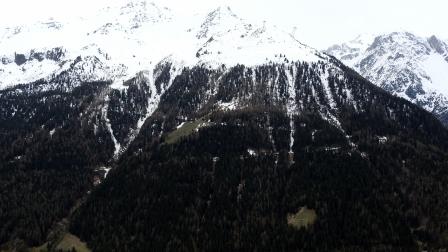
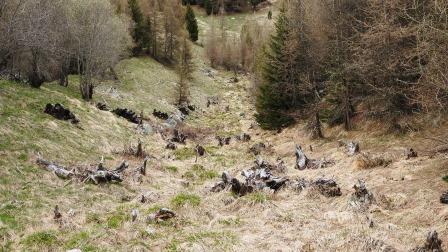
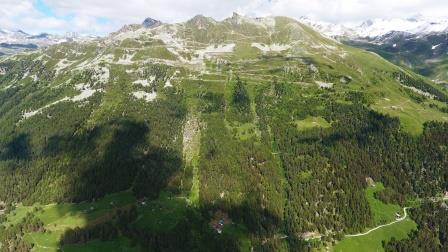
Where you’re standing is the middle of an av- alanche path. Actually, the last time one came down was in February 1999 and it ran beyond this road. Thirty avalanche paths currently threaten our roads and villages making ava lanches one of the most constant and great- est hazards of this valley. Avalanche starting zones are generally located at an elevation of 2,600 meters, and the run out zone extends as far as the Navizence.
For the protection of people living in the mountain year round as well as the promo- tion of tourism activities, municipalities, with the help of the Local Government and the Confederation,
have initiated an avalanche prevention and mitigation programme comprising a number of structural measures that include:
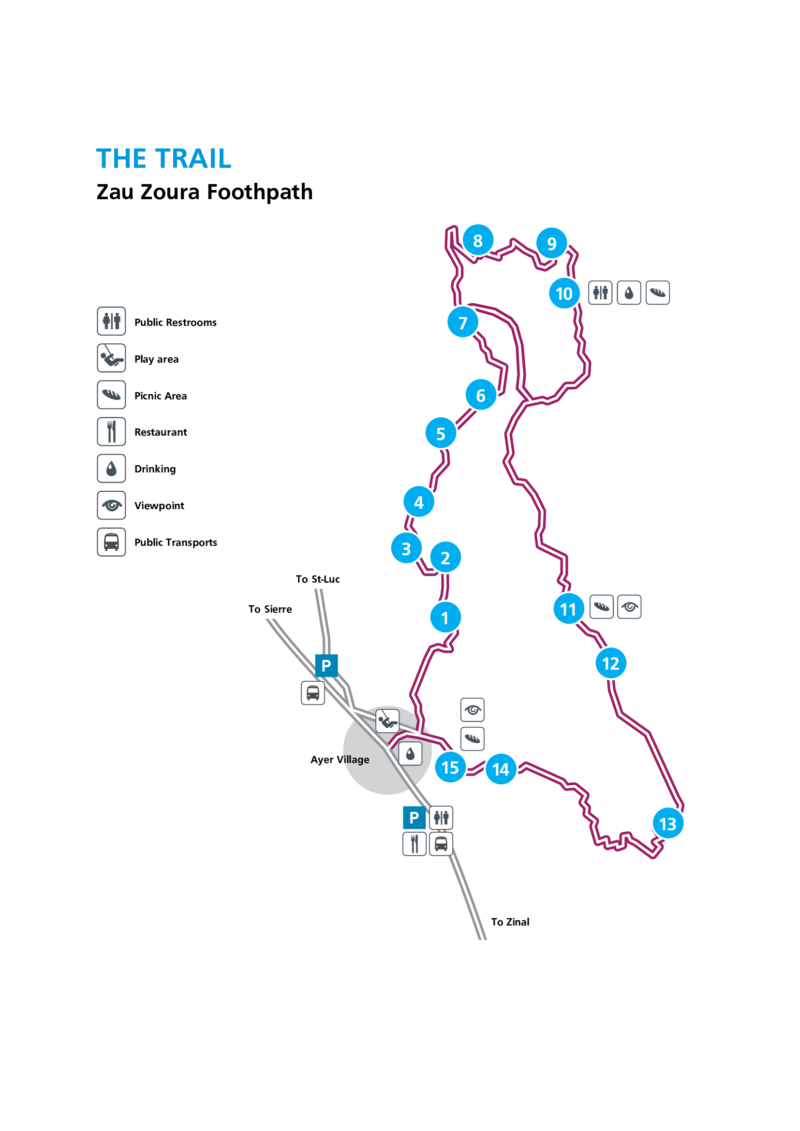
• Wooden Snow Rakes or Barriers – Installed in the forest, they last about 40 years and enable the forest to grow thickly enough to make them redundant (You can see some wood barriers at Station n°12).
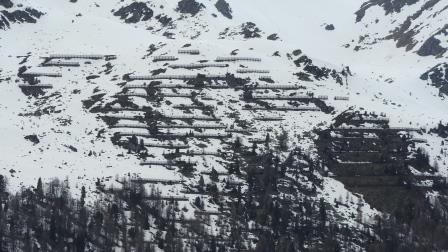
• Snow Bridges – Placed above the forest, they are made of metal and longer lasting (There are some examples opposite, above St-Jean village).
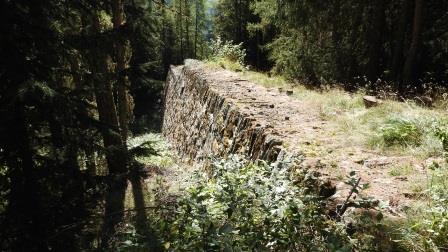
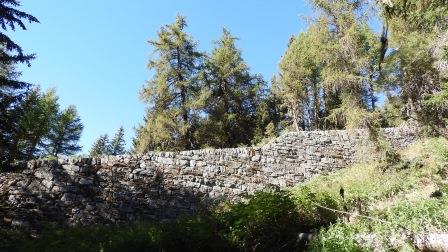
• Deflecting Dams – They form a wedge to protect settlements by deflecting the snow away from populated areas. The first such structure was built in Anniviers in the 50’s and is made of dry stones. It is situated not far from here, north of the Déjerts.
• You can observe a similar structure made of earth at Station n°10.
• Catching Dams – They are large earthen structures designed to hold the snow brought down by the avalanche. (One such dam can be seen on the mountain facing us, under the Roc d’Orzival. It was built to protect Mayoux village which had been partially destroyed in 1817).
Artificial triggering of small avalanches by detonating charges is sometimes necessary to prevent dangerous snow accumulation in avalanche starting zones. At times of hazards and when explosives are deployed, access roads to villages are closed.

 DCIM100MEDIADJI_0050.JPG