It’s an amazing story, full of surprises
The history of this landscape began a long time ago… 250 million years ago, a mas-sive upheaval occurred, namely the breakup of Pangaea, a giant continuous land mass known as a supercontinent… As the conti-nent broke up an ocean was born called Te-thys. At the bottom of the ocean, sediments were deposited that solidified into sedimen-tary rocks (i.e. Sandstone), thus forming the raw material that would constitute the Alps.
Roughly a hundred million years ago, the movement was reversed: the Tethys gap slowly closed as the two continents got closer. The Alps were thrust out of the ocean under the effect of numerous earthquakes caused by the stress exerted on sedimentary rock of the Tethys basin as it subducted under the African continent.
One player is still missing in our landscape story i.e. erosion. 30 million years ago the young Alps must have looked like the Himala-yas. Huge amount of pebbles, sand and clay were removed from bed and banks then de-posited by rivers in what was left of Tethys, at the foot of the mountains.
During the last two million years, the climate changed considerably. Over the course of sev-eral successive glacial stages, ice accumulated everywhere and huge glaciers filled Alpine valleys, covering the Jura and flowing into the surrounding plains. The glaciers can accelerate ate the erosion process, deepening valleys, carving circuses and protrusions and giving its varied shape to the mountains.
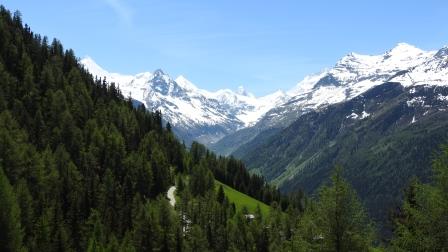
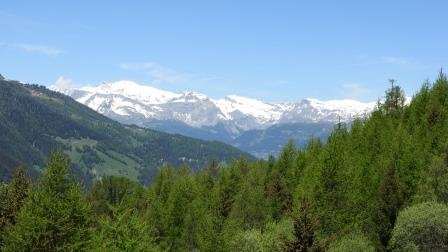
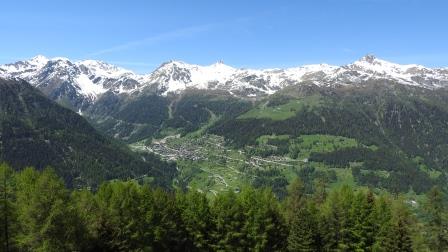
The Val d’Anniviers is a multilayer geological system.
Today, the three key factors of this long his- tory (rocks, collision and erosion) can be detected in the Val d’Anniviers landscape which can be compared to a big aslant multilayer sandwich:
1 In the foreground underneath it all with a boundary that sinks towards the South at the level of Zinal, the gneisses and quartz-ites of the old Europe. You are currently walking on those rocks.
2 In the middle, the huge remains of the bottom of the disappeared ocean: limestone, shale and underwaterlava.
3 In the back and over, like a big roller crush-crusher, the granite and gneiss rocks of the old African continent. Little is left of this continent, whose proud representatives amid the 4000 summits of Valais Alps include the Weisshorn, the Dent Blanche, and the Matterhorn.