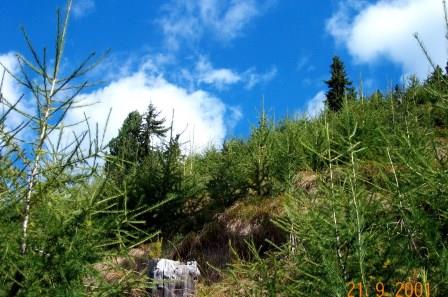
This woodland is called Zau Zoura, a dialect phrase meaning “sworn forest”. The name originated in a decison to ban all timber extraction for decades that was made by the villagers who were aware of the protective role forests can have against avalanches and rockfalls.
One of the consequences of the ban was a significant densification of the forest. The reason is that as trees get older the canopy stops the light and part of the rainfall from reaching the ground, then, deprived of light and water, seeds cannot germinate and naturally produce new trees. As a result, at the end of the 1980s, most spruce trunks showed marked signs of aging and instability.
This was evidenced during windstorm “Vivian” which overturned more than 80% of trees on a 4.5 ha area on Febru-ary 21 and 22, 1990.
From an environmental point of view the occurrence of violent phenomenons – fires, storms or avalanches-, is not a problem in itself. In fact, the destruction of a dense uniform forest enables other living creatures to colonize the area. In the medium term, all creatures will find their place and use the available space and resources to form a new, richer and more balanced, ecosystem. For people however, these events are viewed as natural disasters since the destruction of the protective forest temporarily leaves infrastructure—villages, roads and crops – exposed.
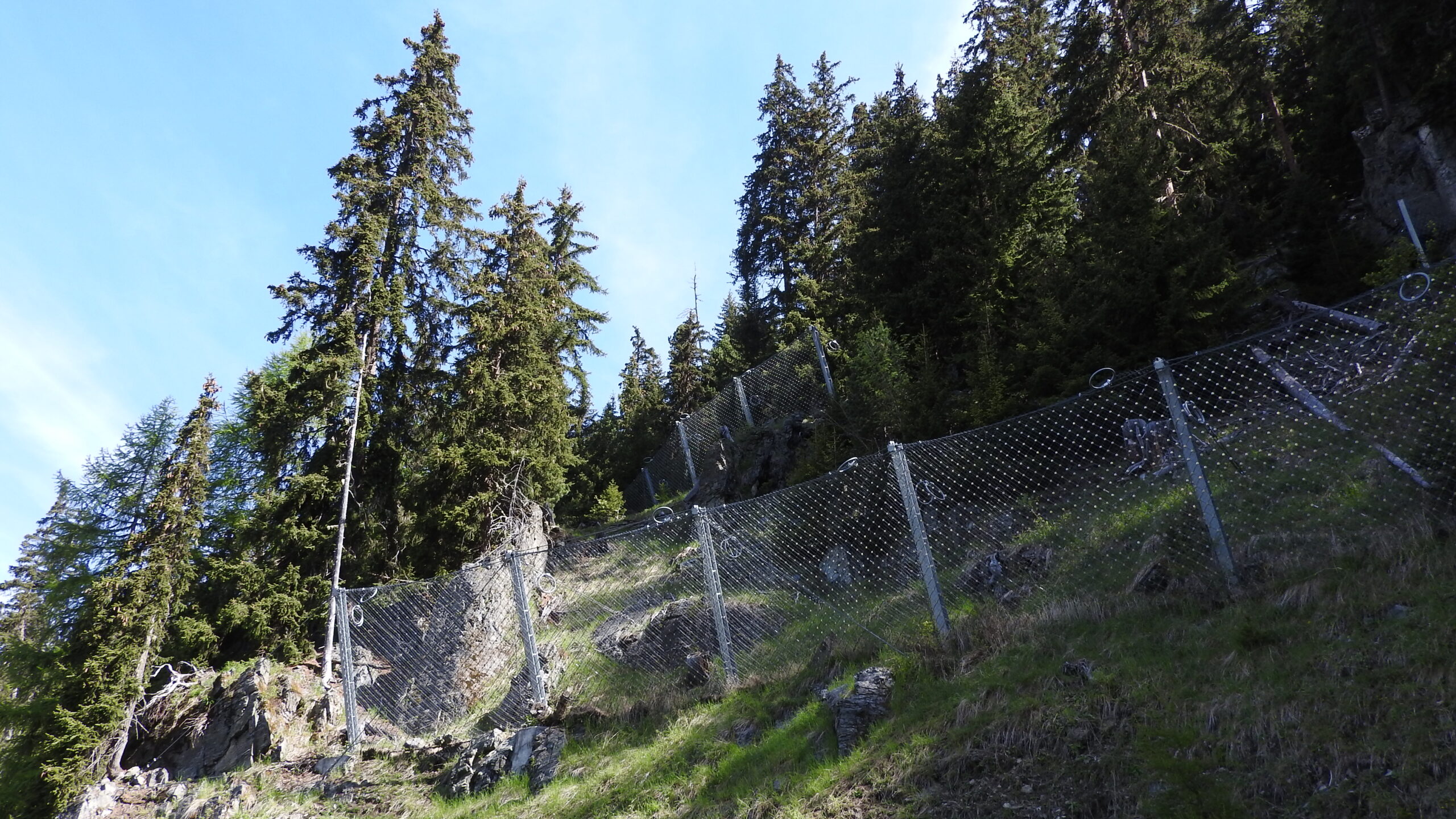
In ther aftermath of the windstorm, large scale works were undertaken to protect Ayer village and the cantonal road from Vissoie to Zinal. First, avalanche barriers were built, then wooden tripods. These technical measures effectively alleviated the pressure of the snow against recently planted young trees – approximately 10’500 larches and 3’000 mountain-ashes -. A drip irrigation system was installed to ensure planting success. Five years later, you could see that 95% of young shoots were thriving.
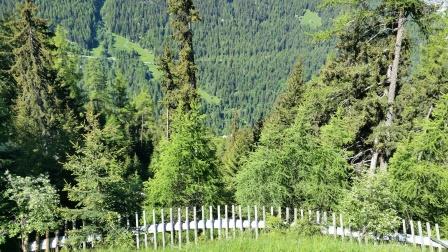
Today, we are seeing a rejuvenated and mixed forest where larches, spruces and Arolla pines grow side by side. The intermediate layer composed of broad leaved trees, mountains ashes and some willow varieties provides ungulates (stags and deer) with buds to eat and branches to rub their antlers against. In addition, the ground is now covered with grass plants. Several clearings both embellish the forest and allow the light in, ensuring a rich and beautiful biodiversity. These heterogeneous structural elements are the first stage of a semi permeable woodland that will enable the Zau Zoura forest to play its protective, productive as well as social part, in a sustainable way.

 ?
?