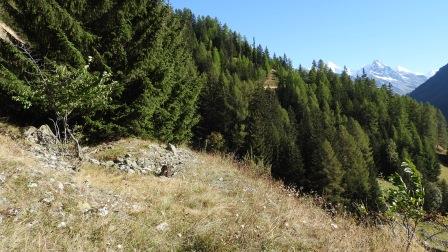
How long could you withstand the noon sun on this slope on a July day? Lucky are you that you can move to find some shade or go to the village fountain. But the deeply-rooted plants under your feet cannot budge! Nevertheless, you will not see them complain. The reason being that here you will find some of the spe-cies best adapted for living in very hot and dry surroundings. They are called xerothermophiles.
They adapt in various ways, reducing leave size and surface, pleating leaves, increasing fuzziness, covering themselves in light-color-ed wax, increasing their root suction strength, growing a widespread root system that col-lects subterranean water and developing the ability to store water…
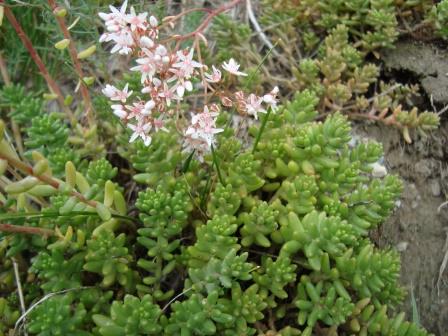
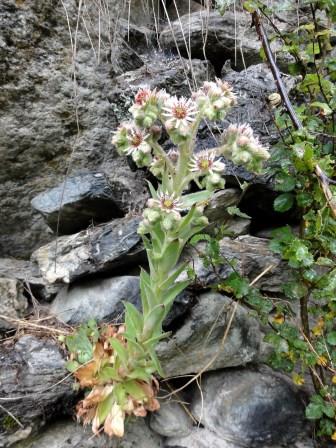
For instance, the white stone crop (Sedum album), with its thick, small sized oval leaves, which grows on rocks. Like the houseleek (Sempervivum tectorum), it is part of the cras-sulaceae family and stores water in its leaves which get thicker. Its roots can pump water with a suction power of more than 15 times the atmospheric pressure!
Heterogeneous soil pH
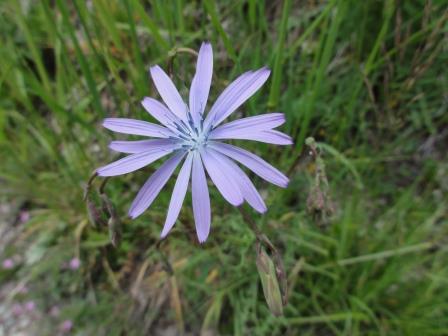
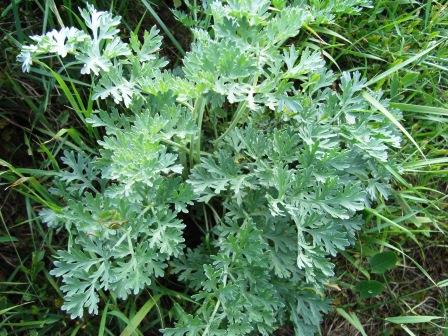
The draining soil found at this station was formed on a moraine which appeared when the ice receded. Moraines are accumulations of dirt and rocks, that have fallen onto a glacier surface, or have been pushed along by glacier movement. Here, the source rock is silicon (acid pH ), but on the surface the soil may contain pockets of calcium (neutral-basic pH.) as indicated by the presence of barberry (Berberis vulgaris) and mountain lettuce, (Lactuca perennis) The latter prefers calcare-ous soil and bears beautiful bluish-rose flow-ers like chicory. However the presence of absinth wormwood (Artemisia absinthium),- the famous ingredient in absinth, with spirally arranged glaucous green leaves, does indicate more acid silicon areas.
Parasite plants
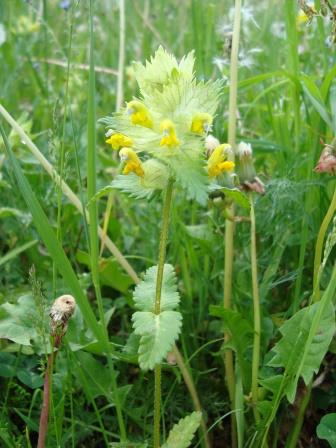
Look for long red vines curled around thyme or a leguminous plant. It’s called dodder (Cuscuta epithymum) and is a holoparasite i.e. it taps into the host plant’s stem to get water, minerals and sugar (i.e energy). It does not need chlorophyll to absorb sunlight unlike the greater yellow-rattle (Rhinantus alectorol-ophus) that you can see higher up. This plant is still green, a sure sign that it synthesizes its own sugar; however it taps into the roots of grass plants to get water and minerals. It is referred to as a semi parasite.
This poor, draining, sundrenched soil with a heterogeneous pH is difficult and varied. No specie can dominate others by over-growing. As a result many flowering species can find their place. Their concentrated nectar attracts numerous insects. The biodiversity of such a meadow is extremely rich and fragile. A good practice to preserve it, for instance, is to graze goats instead of cattle.